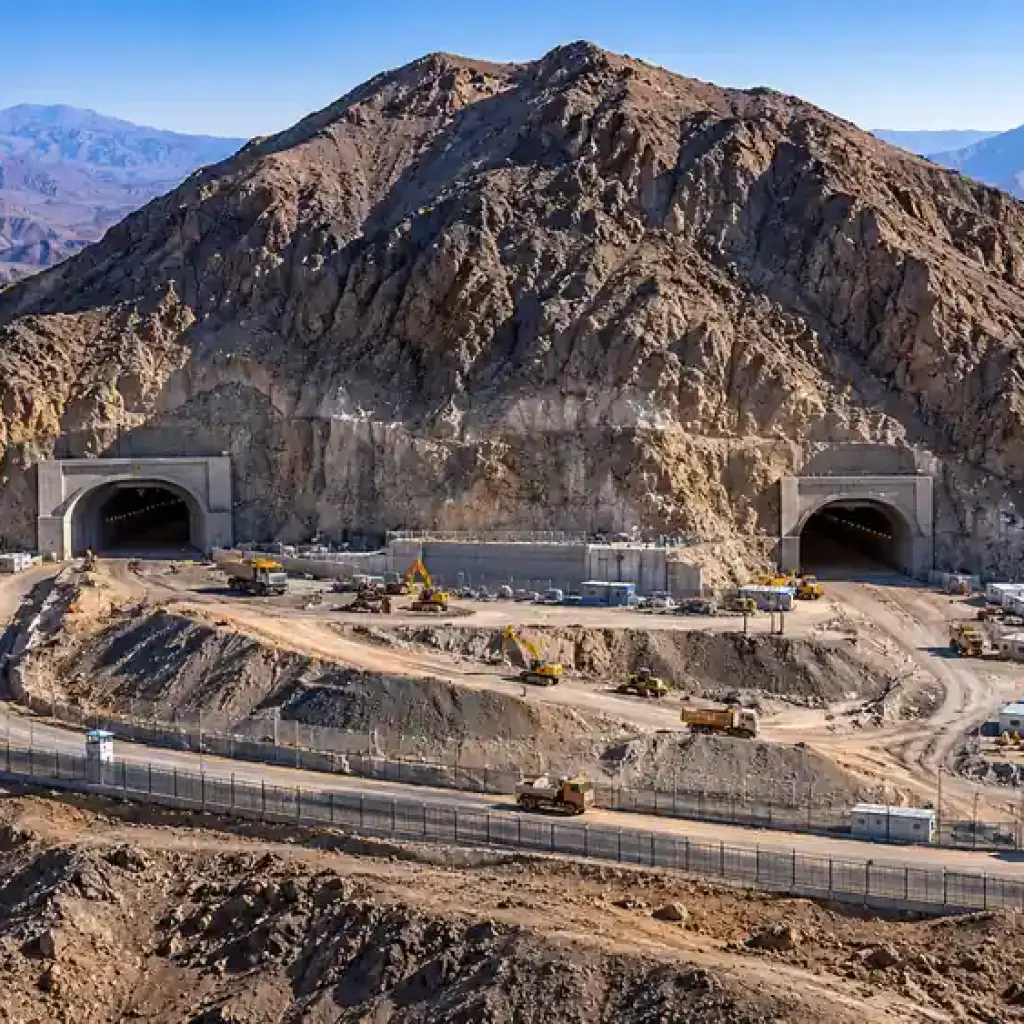
A vast underground complex is rising inside a mountain in central Iran, between two of the country's key nuclear locations. New satellite imagery shows the work moving at an unusual speed, and researchers say its purpose is still unknown.
Iran is racing to build a large fortified underground complex inside a mountain in central Iran, positioned between two of its most significant nuclear locations. The work is raising fresh questions about how Tehran is trying to rebuild and strengthen its strategic capabilities after the US and Israeli strikes.
The details come from new satellite imagery studied by the Institute for Science and International Security, a research group based in Washington. Its analysts found an unusually fast pace of construction at the Behjatabad underground facility.
Researchers say the complex could serve several military purposes, including the housing of major weapons systems. They have not ruled out a connection to Iran's nuclear programme either. For now, though, even the experts studying the images are cautious about drawing conclusions. "The function of the facility is not clear at this time. More information is needed to make an accurate assessment," the institute said in an assessment posted on X on November 25.
A mountain between two nuclear hubs
Behjatabad is being built into a mountain that sits between the Isfahan nuclear site and the Natanz area, home to some of Iran's most important nuclear infrastructure. Natanz is widely known as the centre of Iran's uranium enrichment work, while Isfahan hosts a uranium conversion complex. Satellite imagery supplied by Vantor Technologies and dated November 24 shows extensive construction activity at the location.
A review of earlier images points to a longer timeline than many might assume. Work appears to have begun in December 2025, well before the latest US and Israeli military campaign against Iran started in February, and it expanded considerably throughout 2026.
Iran has built numerous underground facilities across the country, so the concept itself is not new. What sets Behjatabad apart, researchers say, is how quickly it is taking shape. The institute plans to publish more satellite imagery and a more detailed assessment in an upcoming report.
Pace is the central puzzle. Work that began in December 2025 and continued to expand through 2026 shows that the project kept moving even after the military campaign got under way. Researchers are therefore comparing each new image with earlier ones to measure how far the site has advanced.
Why burying a site matters
Facilities placed deep inside mountains are far harder to damage from the air, which is why underground construction has long featured in Iran's strategic planning. Israel and the United States struck Iranian nuclear locations, including Natanz, Fordow and Isfahan, in June 2025. Against that backdrop, any new site built into solid rock draws close attention from analysts.
The uncertainty cuts both ways. A facility designed to house weapons systems would carry one set of implications for regional security, while a link to the nuclear programme would raise another, particularly given its position between Isfahan and Natanz. The institute has chosen not to guess.
Israel signals it can act alone
The discovery arrives at a particularly sensitive moment. On Thursday, Israel declared that it is prepared to strike Iran independently, even without American military support. The statement gives added weight to every new piece of evidence about Iranian construction, since each development shapes how governments judge the risks they face.
For now, Behjatabad remains an open question. Researchers are watching its progress closely, and the coming report is intended to give a fuller picture of the site. Until then, the true purpose of the facility, whether tied to major weapons systems or to the nuclear programme, stays unconfirmed.
Source: Gulf News