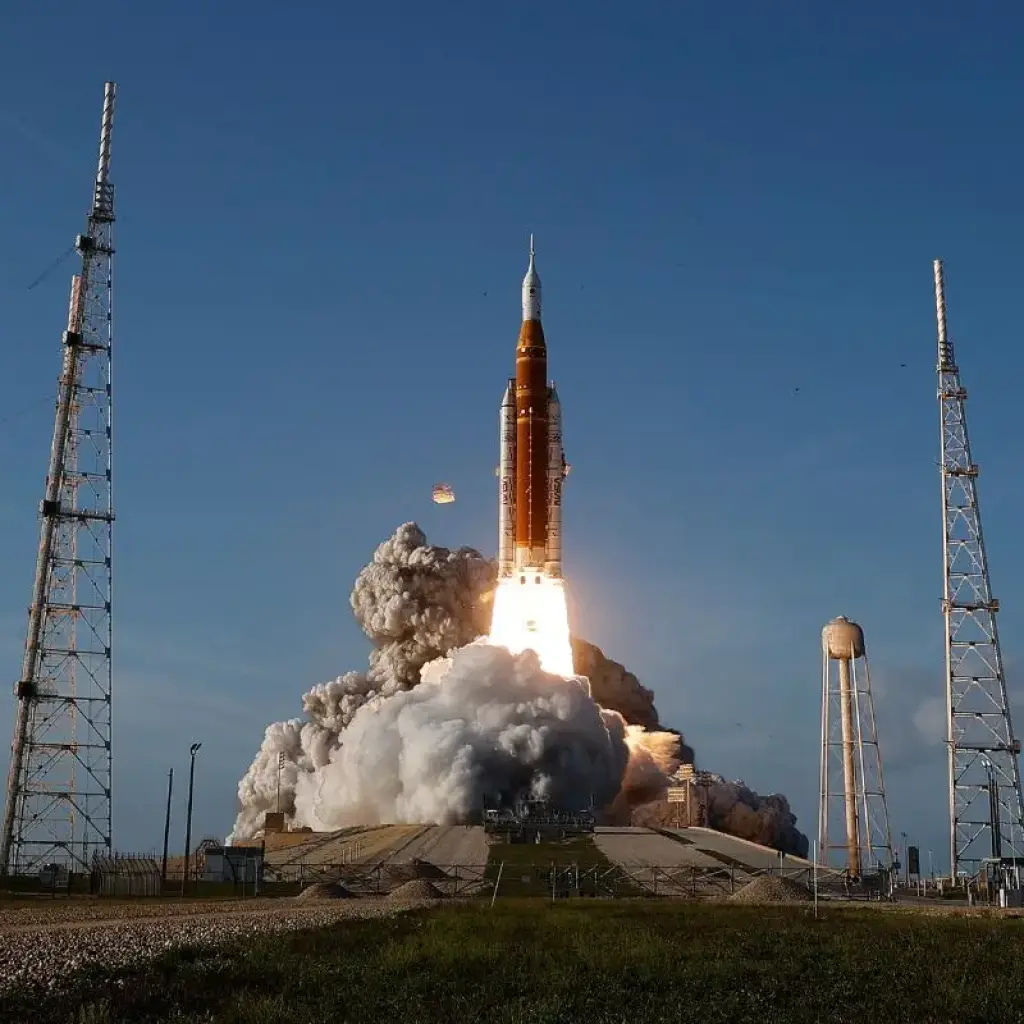
In a landmark moment for space exploration, NASA has successfully launched its first crewed mission to the Moon in more than five decades. The powerful Space Launch System (SLS) rocket lifted off from Cape Canaveral Space Force Station in Florida, sending four astronauts aboard the Orion spacecraft on a historic journey that marks a major step toward humanity’s return to the lunar surface.
The launch took place at approximately 6:35 pm local time, with the massive orange-and-white rocket producing a thunderous roar as it ascended into the sky. The mission, named Artemis 2, carries three American astronauts and one Canadian astronaut who will orbit the Moon before safely returning to Earth. The event has generated excitement worldwide, symbolizing a renewed era of deep-space exploration.
US President Donald Trump praised the launch, calling NASA’s first crewed lunar mission in over 50 years "completely successful" during remarks made shortly before the launch window opened. The Artemis 2 mission had faced multiple delays in recent years due to technical challenges, highlighting the complexity and precision required for human spaceflight beyond Earth’s orbit.
Astronauts Represent Global Unity in Space Exploration
The Artemis 2 crew includes American astronauts Reid Wiseman, Victor Glover and Christina Koch, along with Canadian astronaut Jeremy Hansen. Together, they represent international cooperation and shared ambitions in space exploration.
As the spacecraft began its journey, excitement was evident both inside the capsule and among spectators gathered near the launch site. Hundreds of thousands of people reportedly traveled to Florida’s Space Coast to witness the historic event firsthand.
"We're going to the Moon!" one onlooker exclaimed.
The astronauts themselves expressed pride and optimism ahead of the mission, emphasizing the significance of the journey not only for scientific discovery but also for humanity’s future in space.
“We are going for all humanity”
-Jeremy Hansen, Canadian astronaut
During final preparations before liftoff, Artemis launch director Charlie Blackwell-Thompson delivered an inspiring message to the crew, highlighting the global importance of the mission.
"Reid, Victor, Christina and Jeremy: On this historic mission, you take with you the heart of this Artemis team, the daring spirit of the American people and our partners across the globe, and the hopes and dreams of a new generation. Good luck. God speed Artemis 2. Let's go," she said.
Mission commander Reid Wiseman also shared his excitement shortly after liftoff.
"We have a beautiful moonrise. We're headed right at it," said Wiseman, the mission commander.
Mission to Test Spacecraft Capabilities
After reaching Earth’s orbit, the Orion spacecraft will undergo a series of technical checks to ensure the reliability of systems that have not previously been tested with humans onboard. Engineers and mission teams will closely monitor spacecraft performance before the astronauts proceed toward the Moon.
During the mission, astronauts will test navigation systems and manual piloting capabilities through docking simulations. These tests are considered critical to preparing for future lunar landing missions under the Artemis program.
If all systems perform as expected, the spacecraft will begin its journey around the Moon within days of launch. The full mission is expected to last approximately 10 days, including a three-day journey to lunar orbit before returning to Earth.
The Artemis 2 mission is widely seen as a major stepping stone toward NASA’s long-term goal of landing astronauts on the Moon again by 2028. The planned lunar landing will mark the first time humans have set foot on the Moon since the Apollo missions ended in 1972.
A Major Step for Humanity
Scientists, engineers, and space enthusiasts across the world have welcomed the mission as a major achievement in human exploration. Many experts believe the Artemis program could open the door to deeper exploration of Mars and other destinations in the solar system.
Sian Proctor, an American scientist who attended the launch event, expressed excitement about humanity’s return to lunar exploration.
"This was amazing," said Sian Proctor.
"I'm just so happy that we're going back to the Moon, and everybody should be excited and be following the next 10 days, because this is a big step for humanity," Proctor said.
The Artemis 2 mission not only represents technological progress but also demonstrates global collaboration and determination to explore beyond Earth. With successful completion of this mission, NASA will move closer to establishing a long-term human presence on the Moon, paving the way for future space exploration missions.
Source : Gulf News
Image source : Mathrubhumi English